Monday, 21 March 2016

New iPhone 5se 10 features you should expect.


On Monday, Apple is expected to introduce a new iPhone called the "iPhone SE." Originally people believed this phone would be called iPhone 6c, until 9to5Mac's Mark Gurman said the name would actually be "iPhone 5SE."


So, what is the iPhone SE?

Here's what you need to know before Apple unveils this new phone on Monday.


According to Jackdaw Research analyst Jan Dawson, there are about 200-250 million people who still own an iPhone with a 4-inch screen (either the iPhone 5 or iPhone 5S). It's not clear why those people don't have a newer phone; maybe they find newer phones too expensive, or maybe they simply prefer a smaller screen size. Either way, the return of the 4-inch iPhone the first model of its kind in about three years — will be Apple's way of appealing to those tens of millions of customers.


The 4-inch screen won't be the only similarity the iPhone SE has with the iPhone 5S. In fact, 9to5Mac's Mark Gurman says the iPhone SE will look "identical" to the iPhone 5S, with its round volume buttons, volume button on top of the phone, and chamfered edges along the outside. It will even have the same speaker and microphone locations (at the bottom of the phone), and the back of the phone will also look identical with metal in the center and glass on the top and bottom.


Since the dimensions of the two phones are reportedly identical, anyone who owns an iPhone 5S will be happy to know their case will work with this new 4-inch iPhone.


. Though this phone might look like an iPhone 5S, its performance will blow away any current iPhone 5S owners. Gurman says the iPhone SE will feature the A9 chip and M9 coprocessor from the iPhone 6s, which will let people activate Siri simply by saying "Hey Siri.


Unlike the iPhone 5S, the iPhone SE will reportedly come with Apple Pay, which lets you pay for goods simply by placing your phone near a special transponder and holding your thumb on the fingerprint sensor ("Touch ID") to authenticate the purchase.


. Aside from the Galaxy S7 Edge, the iPhone 6s and iPhone 6s Plus have some of the best cameras ever put in a smartphone. Luckily for prospective owners, the iPhone SE will come with the same 12-megapixel camera with 4K video support as the iPhone 6s. We're guessing that means it will also support Apple's Live Photos feature, which captures moments before and after each shot to make your photos come alive when you touch them.


Gurman says the iPhone SE will have improved connectivity hardware for both WiFi and cellular connections. We're guessing it'll have the same setup as the iPhone
6s, which offered support for more LTE bands (including superfast LTE Advanced), and WiFi connectivity that was twice as fast as previous models. 

 The iPhone SE will only be available in 16 GB and 64 GB flavors, and the 64 GB model will probably be $100 more. If you're thinking of buying this phone, we recommend buying the 64 GB model. As we've explained many times, 16 GB just isn't enough space for most people. You'll want more storage so you can listen to music, take plenty of pictures, and download apps without getting annoying notifications to make more room on your phone.


You'll be able to buy an iPhone SE in four colors: silver, space gray, gold, and rose gold. Since the iPhone SE will replace the iPhone 5S in Apple's current iPhone lineup, the SE will start at $450 for the basic 16 GB model. We're guessing the 64 GB iPhone SE will cost $550.We'll get the official word on the iPhone SE at Apple's media event on Monday. Tech Insider will be in attendance and covering the event throughout the day.

World Down Syndrome Day (21st march)


What is Down Syndrome?

Down syndrome is a congenital condition caused by an extra chromosome. The presence of an extra number 21 chromosome causes the distinctive facial features, physical characteristics and the cognitive impairments seen in people with Down syndrome. While people with Down syndrome have some characteristics in common, it is very important to remember that each person with Down syndrome is an individual with strengths and weaknesses. Never make assumptions about a person’s abilities based on their diagnosis.

To really understand what it means to have an extra chromsome, it helps to have some basic information about chromosomes.
Chromosomes

Chromosomes are basically the packages of genetic information that are found in every cell of the human body. Most humans have 46 chromosomes arranged in pairs for a total of 23 pairs of chromosomes. There are twenty-two pairs of what are called autosomes and one pair of sex chromosomes.

Women have two X chromosomes and men have an X and a Y chromosome. People with Down syndrome have an extra number 21 chromosome - a condition that is also called trisomy 21. Instead of 46 chromosomes, they have 47. Having three copies of the genetic material on chromosome 21 is what causes Down syndrome.
History

Down syndrome was first described by Dr. John Langdon Down in 1866. He was a physician in England with a special interest in mental retardaton. While he was the first to describe some of the distinctive characteristics of people with Down syndrome, it wasn't until 1959 that the cause of Down syndrome, an extra chromosome 21, was discovered by Dr. Jerome Lejeune who was studying chromosomes (a speciality called cytogenetics). Chromosomes can be seen under a microscope and Dr. Lejeune was the first to see 47 chromosomes in the cells of an individual with Down syndrome rather than 46.
The Purpose of Lists

It is somewhat unfair and misleading to simply list all of the symptoms of Down syndrome because each person with Down syndrome is unique, and no one person with Down syndrome will have all of the symptoms listed. The purpose of this list is to provide a basic overview and give you the knowledge that you need to be proactive in caring for your child.
Facial and Physical Features

Individuals with Down syndrome have some distinct facial features that cause them to resemble one another, as well as their families. They can have almond shaped eyes with epicanthal folds, light-colored spots in their eyes called Brushfield spots, a small somewhat flatter nose, a small mouth with a protruding tongue, and small ears. They also have round faces and somewhat flatter facial profiles.

Other physical features seen in people with Down syndrome include a single crease across the palms of their hands, short stubby fingers and a fifth finger that curves inward called clinodactyly. They have a smaller head that is somewhat flattened in the back (brachycephaly), and straight hair that is fine and thin. In general, they tend to have short stature with short limbs, and can have a larger than normal space between the big and second toes.
Medical problems

Children with Down syndrome are at higher risk to develop a number of specific medical problems. While most people with Down syndrome do not have serious medical problems, it is good to be aware of potential complications so that appropriate medical treatment can be sought early before serious complications arise.

Almost all infants with Down syndrome have low muscle tone which is called hypotonia. This means that their muscles are somewhat weak and they appear floppy. While this isn’t a medical problem per se, it is important because muscle tone can affect a child with Down syndrome’s ability to learn and grow. Hypotonia cannot be cured but it generally improves over time.

Hypotonia can also lead to some of the orthopedic or bone problems such at atlantoaxial instability that some people with Down syndrome can have.

The majority of children with Down syndrome will have some type of vision problem such as nearsightedness, farsightedness, crossed-eyes and even blocked tear ducts. About 40% of babies with Down syndrome are born with heart defects which can range from mild to severe. Somewhere between 40-60% of babies with Down syndrome will have some form of hearing loss. Other problems seen less frequently include gastrointestinal defects, thyroid problems and very rarely leukemia.
Mental Retardation

All individuals with Down syndrome have some degree of mental retardation. They learn more slowly and have difficulties with complex reasoning and judgement, but they do have the capacity to learn. It is impossible to predict the degree of mental retardation in an infant with Down syndrome at birth (just as it is impossible to predict the IQ of any infant at birth).

It is very important that infant and people with Down syndrome receive the support, guidance, education and appropriate treatments needed to maximize their potential and to allow them to live fulfilling lives.


HappY BirtHDaY TwitteR. Here are Some FactS of TwitteR


347,000 Tweets are sent every minute.


Twitter
is more addictive than
cigarettes and alcohol,
According to a study.


"Friendstalker" was one of the early names considered for Twitter.

Twitter Slang Dictionary

The FBI has a Twitter slang dictionary.

The official Twitter account of @Sweden is given to a random citizen every week to manage.

In 2013, a fake tweet temporarily wiped out US$130 billion off the stock market.

In 2014, there are about 350,000 tweets and 382,000 Facebook likes every minute.

A day's worth
of Twitter posts
would fill a
10-million-page book.

Every tweet Americans send is being archived by the Library of Congress.


The CIA reads up to
5 million tweets a day.

Justin Bieber has more followers on Twitter than Spain has people.

The U.S. Government
created a  Twitter clone
for Cubans in 2011.

Facebook, Twitter and The New York Times have been blocked in China since 2009.

44% Of registered Twitter users have never tweeted

After Michael Jackson's death hit the news, he was mentioned in a rate of 5,000 tweets per minute.

 
LARRY

Twitter's bird is called Larry.

In 2011, Twitter users tweeted the equivalent of 8,163 copies of "War and Peace" every day.


According to the Vatican, you can reduce the time you spend in purgatory by following the pope on Twitter.


Around 50% of Justin Bieber's followers on Twitter are fake, a report found.

There's a Twitter account that narrates WW2 in "real-time."


Twitter bought Vine for US$30 million several months before it was even officially released.

In April, 2013, someone hacked Associated Press' Twitter account and tweeted that 2 bombs had exploded at the White House. The stock market crashed within seconds.

90% of the world's
Internet Users Don't Use Twitter.


In 2012, Venezuela's President Hugo Chavez rewarded his 3,000,000th Twitter follower, a
19-year old girl, with a new home.

Barack Obama has the most followers on Twitter of any world leader.

n 2016, a court in Saudi Arabia sentenced a man to 10 years in prison and 2,000 lashes for asserting his atheism through Twitter posts.


Sunday, 20 March 2016

13 reasons why keeping 'Mahabharat' at home can be dicey


Usually, people do not choose to keep the Mahabharat epic in their homes. Instead, one can find Tulsidas’s Ramcharitmanas, Valmiki’s Ramayan or Shrimad Bhagwad Puran in their houses.

Mahabharat is also known as the 5th Veda, but it is still not kept at home. The older reasons for this action that keeping Mahabharat at home disturb the peace of the house and fights begin. But this tradition behind not keeping Mahabharat in house is not true.

Click on this slide show to know some facts about Mahabharat because of which people don't prefer to keep a book like this at home...

Mahabharat is an epic of relations. One can find family, societal and political relations explained well in this epic.  There are many relations explained in this epic that a common person will find it difficult to understand. For instance, the Pandavas were born from different Gods, but their father is one.

Also, that Draupadi has five husbands, which in today’s time is neither understood not accepted. Such woman in modern times are understood as prostitutes.

There are many other things mentioned in this book that is not understood by people in general. This is the main reason by the elder in the family do not allow keeping these books at home.

Click on further slide to know the meaning of the sign Duryodhan made to Draupadi…

 After losing the game of gamble, Duryodhan had asked Draupadi to sit on his left thigh. For most people, this is the reason why he is the villain. Although his this action was bad, but according to the tradition that was followed during that time, a king would ask his wife to sit on his left thigh and daughter on the right. This is the reason why religious posters and calendars show the goddesses on the left side. Even in Hindu marriages, the wife is made to sit on the left side.


Most people know that Mahabharat has been written by Ved Vyas. This is not completely true. Ved Vyas is actually not a name, but a surname. This surname was given to those who had all the knowledge od all the Vedas. There have 27 Ved Vyas before Krishnadwaipayan. He was the 28th one who wrote this epic. Since he was born dusky, his name was Krishna (Krishna was dark in colour) and he was born on a dweep (island) and hence dwaipayan.

There is not just one Geeta. It is believed that Shrimad Bhagwad Geeta is the only Geeta, which includes the wisdom given by Krishna.  This is true, but there is another fact that there are 10 more Geeta. Vyadh Geeta, Parashar Geeta AND Ashtavakra Geeta is part of those 10 Geeta.
There is no definition of religion

Many people believe that Mahabharat teach about religion. Some people also connect Mahabharat with truth and false. In reality, no instance in Mahabharat proves what is right or wrong. The truth changes in this epic from situation to situation.


One instance of right and wrong comes when Dronacharya asks for Eklavya’s thumb. While most people believe this attitude of Dronacharya to be wrong. But, there was actually nothing wrong in it. According to Mahabharat, once while Dronacharya was bathing in the river, a crocodile had caught him, that time Arjun had saved his life. At that moment, Dronacharya had promised Arjun that he would make him the best bow and arrow shooter. To fulfill this promise, he had asked Eklavya to give his thumb. This proves that there is no definition of what is right and wrong.

There used to be no concept of Zodiac during the time of Mahabharat. The entire astrology was based on the 27 constellations. The dice that was used to play the game of gamble by Shakuni had only four sides instead of six. However, nothing more than this is known about the dice.

Brhamastra used to be made by chanting mantras

Most people believe that Brahmastra are those weapons that were given by Gods after years of meditation. However, this is not the entire truth. While some Brahmastra are clearly visible, there are some that are only in mantras. Like converting the wheel of a chariot into a chakra.


Involvement of foreigners in Indian battles has been our history. In Mahabharat too, foreigners were involved. While people only believe that it was a war between the Pandavas and Kauravas. There were many Romans and Macedonians had participated in the war.

It is a common known fact that Abhimanyu was killed by the 7 maharathi with a chakravihiyu. According to Maulik Mahabharat, Abhimanyu had fought with bravery and killed Duryodhan’s son out of the 7 maharathis. Angry with this, Dusashan’s son had killed Abhimanyu.

Mahabharat has been written in three phases. In the first phase, 8,800 shlokas were written, in the second phase, 24 thousand shlokas were written and one lakh shlokas were written in the final phase.

Saturday, 19 March 2016

Hindu mythology: Some of Unknown facts about Kauravas!


Hindu mythology is very rich and very interesting. Alas, for most of us, the sources of knowledge are TV serials like Ramayana, Har Har Mahadev, Mahabharata etc. We hardly read the authentic Hindu mythology texts that are available in both Hindi and Sanskrit. In this blog, let me tell you about some lesser know facts and stories about Kauravas…

All of us know that it was Sage Veda Vyasa who composed Mahbharata with the help of Lord Ganesha but do you know that he was the one responsible for the birth of Pandu and Dhritarashtra. So basically, he penned down the future and history of his sons, grandsons and the intricate political turmoil that haunted their lives and was resposnbile for their deaths.

How were the 100 Kauravas born and what were their names?

It is belive dthat Gandhari was pregnant for a very long time. After many years, she got frustrated and punched her stomach so hard that she had a miscarriage. Sage Vyas, put the parts of that foetus into a hundred ponds and got them covered. After years of wait, the pieces of the foetus turned into children. The first one to come out of his pond was Duryodhan.

Here are the names of all the Kauravas:

Duryodhan, Dussashan, Dussah, Jalsandh, Sam, Sah, Vind, Anuvind, Dudrdharsh, Subahu, Dushpradharshan, Durmurshan, Durmukh, Dushkarn, Karn, Vivinshati,Vikarn, Shal, Satva, Sulochan, Chitr,Upchitra, Chitraksh, Charuchitr, Shrasan, Durmud, Durvigah, Vivitsu, Viktanan, Urnanabh, Sunabh, Nand, Upnand, Chitrban, Chitravarma, Suvarma, Durvimochan, Aayobahu, Mahabahu, Chitrang, Chitrkundal, Bhimveg, Bhimbal, Ugrayudh, Sushen, Kunddhar, Mahaodar, Chhitrayudh, Nishangi, Pashi, Vrindarakm, Dridhvarma, Dridhkshatra, Somkirti, Anudar, Dridhsandh, Jarasandh, Satyasandh, Sad: suvak, Ugrashrava, Kundashayi, Dushparajay, Ugrasen, Vishalaksh, Duradhar, Dridhhast, Suvarcha, Adityaketu, Bahvashi, Batveg, Suhast, Nagdatt, Agrayayi, Kavchi, Krathan, Kundi, Alolup, Bhimrath, Dridhrathashray, Raudrakarma, Virbahu, Abbey, Anadhritya, Kundabhedi, Dirgharoma, Dirghabahu, Pramathi, Pramath, Mahabahu, Vyudhorask, Kankadhvaj, Kundashi.

The Kauravas were not really righteous hence they were all mis-named because of their bad repute. Duryodhana was actually named Suyodhana, Dusshasana was actually Sushaasana, Dusshala was actually Suchala and so on.

Shakuni was not helping Kauravas

Shakuni was the brother of Gandhari. However, he stayed in Hastinapur and (mis) guided Duryodhan all the time beasue he wanted to avenge his father’s death. Dhritrashtra was responsible for the horrific death of Shakuni’s whole family. It was Shakuni’s father who broke his leg so that he enevr forgets the injustice done by Dhritrashtra.

Friday, 18 March 2016

Why Do Human Beings need to Sleep? As today is Worlds Sleep Day.


When you’re scrambling to meet the demands of a busy schedule, cutting back on sleep may seem like the only answer. Sacrificing an hour or two of rest in order to get more done may sound like a reasonable trade-off. But the truth is that even minimal sleep loss takes a toll on your mood, energy, mental sharpness, and ability to handle stress. And over the long-term, chronic sleep loss wreaks havoc on your health.

By understanding your nightly sleep needs and what you can do to bounce back from chronic sleep loss, you can finally get on a healthy sleep schedule.
Sleep is a necessity, not a luxury

The quality of your sleep directly affects the quality of your waking life, including your productivity, emotional balance, creativity, physical vitality, and even your weight. No other activity delivers so many benefits with so little effort!

Sleep isn’t merely a time when your body shuts off. While you rest, your brain stays busy, overseeing a wide variety of biological maintenance that keeps your body running in top condition, preparing you for the day ahead. Without enough hours of restorative sleep, you won’t be able to work, learn, create, and communicate at a level even close to your true potential. Regularly skimp on “service” and you’re headed for a major mental and physical breakdown.

The good news is that you don't have to choose between health and productivity. As you start getting the sleep you need, your energy and efficiency will go up. In fact, you're likely to find that you actually get more done during the day than when you were skimping on shuteye.
Myths and Facts about Sleep

Myth 1: Getting just one hour less sleep per night won’t affect your daytime functioning. You may not be noticeably sleepy during the day, but losing even one hour of sleep can affect your ability to think properly and respond quickly. It also compromises your cardiovascular health, energy balance, and ability to fight infections.

Myth 2: Your body adjusts quickly to different sleep schedules. Most people can reset their biological clock, but only by appropriately timed cues—and even then, by one or two hours per day at best. Consequently, it can take more than a week to adjust after traveling across several time zones or switching to the night shift.

Myth 3: Extra sleep at night can cure you of problems with excessive daytime fatigue. The quantity of sleep you get is important, sure, but it's the quality of your sleep that you really have to pay attention to. Some people sleep eight or nine hours a night but don’t feel well rested when they wake up because the quality of their sleep is poor.

Myth 4: You can make up for lost sleep during the week by sleeping more on the weekends. Although this sleeping pattern will help relieve part of a sleep debt, it will not completely make up for the lack of sleep. Furthermore, sleeping later on the weekends can affect your sleep-wake cycle so that it is much harder to go to sleep at the right time on Sunday nights and get up early on Monday mornings.


There is a big difference between the amount of sleep you can get by on and the amount you need to function optimally. Just because you're able to operate on seven hours of sleep doesn't mean you wouldn't feel a lot better and get more done if you spent an extra hour or two in bed.

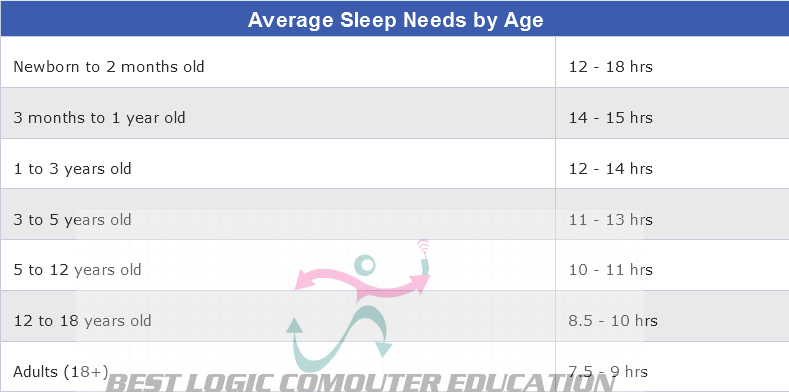
While sleep requirements vary slightly from person to person, most healthy adults need between 7.5 to 9 hours of sleep per night to function at their best. Children and teens need even more (see Average Sleep Needs table below). And despite the notion that our sleep needs decrease with age, older people still need at least 7.5 to 8 hours of sleep. Since older adults often have trouble sleeping this long at night, daytime naps can help fill in the gap.

The best way to figure out if you're meeting your sleep needs is to evaluate how you feel as you go about your day. If you're logging enough hours, you'll feel energetic and alert all day long, from the moment you wake up until your regular bedtime.
Think six hours of sleep is enough?

Think again. Researchers at the University of California, San Francisco, discovered that some people have a gene that enables them to do well on six hours of sleep a night. This gene, however, is very rare, appearing in less than 3% of the population. For the other 97% of us, six hours doesn’t come close to cutting it.
Signs that you’re not getting enough sleep

If you’re getting less than eight hours of sleep each night, chances are you’re sleep deprived. What’s more, you probably have no idea just how much lack of sleep is affecting you.

How is it possible to be sleep deprived without knowing it?
 Most of the signs of sleep deprivation are much more subtle than falling face first into your dinner plate. Furthermore, if you’ve made a habit of skimping on sleep, you may not even remember what it feels like to be wide-awake, fully alert, and firing on all cylinders. Maybe it feels normal to get sleepy when you’re in a boring meeting, struggling through the afternoon slump, or dozing off after dinner, but the truth is that it’s only “normal” if you’re sleep deprived.
You may be sleep deprived if you...

    Need an alarm clock in order to wake up on time
    Rely on the snooze button
    Have a hard time getting out of bed in the morning
    Feel sluggish in the afternoon
    Get sleepy in meetings, lectures, or warm rooms
    Get drowsy after heavy meals or when driving
    Need to nap to get through the day
    Fall asleep while watching TV or relaxing in the evening
    Feel the need to sleep in on weekends
    Fall asleep within five minutes of going to bed

The effects of chronic lack of sleep

While it may seem like losing sleep isn't such a big deal, sleep deprivation has a wide range of negative effects that go way beyond daytime drowsiness. Lack of sleep affects your judgment, coordination, and reaction times. In fact, sleep deprivation can affect you just as much as being drunk.

The effects include:

    Fatigue, lethargy, and lack of motivation
    Moodiness and irritability
    Reduced creativity and problem-solving skills
    Inability to cope with stress
    Reduced immunity; frequent colds and infections
    Concentration and memory problems
    Weight gain
    Impaired motor skills and increased risk of accidents
    Difficulty making decisions
    Increased risk of diabetes, heart disease, and other health problems


Improving sleep quality

It's not just the number of hours in bed that's important—it's the quality of those hours of sleep. If you're giving yourself plenty of time for sleep, but you're still having trouble waking up in the morning or staying alert all day, you may not be getting quality sleep.

The most damaging effects of sleep deprivation are from inadequate deep sleep. Deep sleep is a time when the body repairs itself and builds up energy for the day ahead. It plays a major role in maintaining your health, stimulating growth and development, repairing muscles and tissues, and boosting your immune system. In order to wake up energized and refreshed, getting quality deep sleep is essential.
Factors that can lead to poor or inadequate deep sleep include:

Being woken during the night by outside noise, for example, or in order to care for a crying baby.
Working night shifts or swing shifts. Getting quality deep sleep during the day can be difficult, due to light and excess noise.
Smoking or drinking in the evening. Substances like alcohol and nicotine can disrupt deep sleep. It’s best to limit them before bed.
Exposure to artificial light at night— especially the light from electronic devices, including TVs, computers, tables, and mobile phones.

Thursday, 17 March 2016

HOW SIM CARD WORKS? THE TECHNOLOGY BEHIND SIM .


Mobile phones need SIM cards to connect the user to the network of their choice.

A SIM - short for Subscriber Identity Module - is a piece of plastic that slots into your smartphone (or mobile phone) that acts as your unique ID, so that you can connect to, make calls over and be charged for using a particular mobile phone network.

Without a SIM card, you can't connect to a mobile phone network, although for safety reasons, you can still dial 999.

When did SIMs first appear?

SIMs first appeared with the first digital 'GSM' mobile phones back in 1992. The Nokia 1011 was the first GSM mobile phone to go on sale. Unlike the analogue mobiles before it, GSM mobiles used digital technology for (relatively) interference-free communication — among other benefits.

Why do we use SIMs at all?

The SIM was part of a European telecommunications standard that separated mobile phones from the networks they connected to by moving all the necessary security and identification data onto a chip embedded into a removable piece of plastic the size of a credit card.

Since GSM technology also converted the voices at either end of a call into encrypted digital data before it was sent over the airwaves, the SIM also stored the ‘key’ (essentially a password) needed to decrypt this data.


What else do SIMs store?

The computer chip on a SIM doesn’t have much memory, but it stores a host of information needed to connect to a mobile phone network. This includes a unique ID called the IMSI (International Mobile Subscriber Identity) which is used to connect someone calling your mobile number to your phone, rather than to someone else’s.

SIMs can also store names and telephone numbers, which makes it much easier to switch phones without losing your contact details. This isn’t much of an issue in these days of cloud-based backup, but this innovation was a huge relief to anyone who remembers typing in contact details using the fiddly ‘multitap’ mobile phone keys of the 1990s.

Why are SIMs getting smaller?

The original Full-size SIM was fine for early digital mobile phones, but as mobile communications technology improved and the phones started to shrink, the SIM was soon too large.

The first solution was the thumbnail-sized Standard-SIM. These were still provided as part of a full-size SIM for compatibility with older models, but it could be snapped out for use in newer phones.

Standard-SIMs stuck around for many years, but once smartphones started to get smaller and thinner, space was in short supply. As a result the Micro-SIM standard was created in 2003, but manufacturers didn’t adopt it until 2010; Apple was the first to use it for its iPhone 4.


The Micro-SIM was only a little smaller than the Standard-SIM and most of the missing size was useless plastic. That meant many Micro-SIMs could be cut down to size using widely available tools (or a steady hand and pair of scissors) without otherwise damaging them.

Inevitably it wasn’t long before a still-smaller SIM was needed and, again, Apple was the first to shift to something new. 2012’s iPhone 5 was the first smartphone to use Nano-SIM that did away with all redundant plastic and was essentially just a tiny chip.

What size SIM do I need?

Most modern smartphones use a Micro or Nano SIM, but you can usually use a smaller SIM in a larger slot with a suitable adaptor. If your SIM is too large for your new smartphone, you’ll need to get a new one from your network provider.

[Related story: Getting started with BT Mobile]

What if I want more than one SIM?

Most smartphones only have one SIM slot, but there’s nothing to stop you swapping SIMs if you want to use a cheap pay-as-you-go SIM when you’re abroad, for example. Dual-SIM smartphones are available, however, so they can be a good option if you want to use two different mobile phone numbers on different networks from a single phone.


Can I use my smartphone SIM in my tablet, or vice versa?

It depends on the mobile network, but probably not. Smartphone SIMs are designed for voice and data use whereas tablets are data-only — they can make voice calls with certain apps, but not via a mobile phone network.

There’s nothing to stop you swapping SIMs around to see if it works (you won’t break anything), but the mobile operator will almost certainly block the SIM when it’s not in the intended device and, even if it does work, you may be breaching the terms and conditions for your account.

My SIM is blocked — have I broken it?

SIM cards come with built-in security features to protect your account if your smartphone is stolen. First among these is a four-digit SIM PIN that, if enabled, must be entered whenever you restart your phone to ‘unlock’ it.

Get this PIN wrong (you normally get three tries) and your SIM will be blocked, but a call to your mobile operator will unblock it. SIMs can also be blocked if you don’t pay your bill or if your phone is lost or stolen - but you will need to inform your mobile phone network of the loss or theft for that to happen.